The search box isn't the only search box anymore
For two decades, “being found online” meant one thing: ranking on Google. That's changing fast. A growing share of buyers now ask an AI assistant — ChatGPT, Google's AI Overviews, Perplexity, Gemini, Copilot — and act on the answer without ever clicking a blue link. If your brand isn't in that answer, you simply don't exist for that buyer.
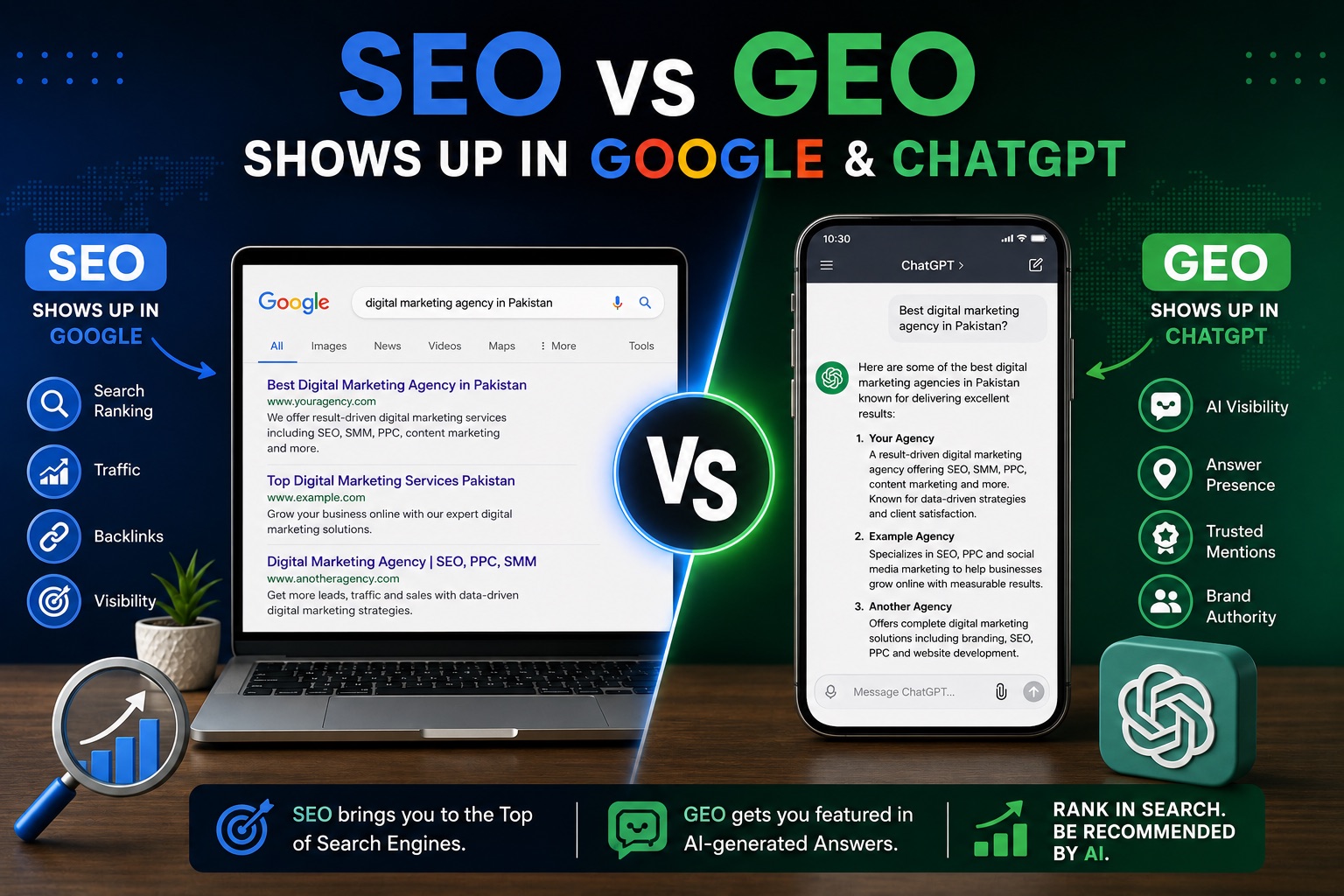
That's where GEO comes in. SEO (Search Engine Optimization) gets you to rank in traditional results. GEO (Generative Engine Optimization) gets your content surfaced and cited inside AI-generated answers. They're cousins, not rivals — and in 2026 you need both.
What is GEO, exactly?
GEO is the practice of structuring your content, authority, and information so that AI models quote and cite your brand when they answer a question. Where SEO optimizes for a ranking algorithm, GEO optimizes for an answer engine that reads, summarizes, and attributes.
The mechanics overlap heavily with SEO — clean content, clear structure, trustworthy signals — but the goal is different. You're not fighting for position #1; you're fighting to be the source the AI chooses to paraphrase.
SEO vs GEO: the real differences
- Goal. SEO ranks you in a list of links. GEO gets you cited inside the AI's answer.
- Surface. SEO lives on Google and Bing results pages. GEO lives in ChatGPT, AI Overviews, Perplexity, Gemini, and Copilot.
- Click behaviour. SEO drives a click to your site. GEO often earns a mention or citation — sometimes with a click, sometimes without.
- Competition. A search page has ten organic slots. An AI answer usually cites just three to five sources — even more winner-take-all.
- Measurement. SEO is rankings, impressions, and traffic. GEO is brand mentions in AI answers, citation share, and referral traffic from AI tools.
What SEO and GEO have in common
The good news: most of the work compounds. Both reward the same fundamentals.
- Clear, well-structured content with descriptive headings.
- Direct answers to real questions — the first sentence matters most.
- Genuine expertise and trust signals (what Google calls E-E-A-T).
- A fast, crawlable, technically clean site.
- Structured data (schema) that tells machines what your content means.
Do these well and you're building for both worlds at once. That's exactly why we run SEO and GEO as a single program, not two separate budgets.
How to optimize for GEO (practical steps)
- Answer the question in the first 2–3 sentences. AI engines lift concise, self-contained answers. Bury the answer and you won't get cited.
- Use clear, question-style headings. “How much does X cost?” as an H2, with a direct answer below it, is highly quotable.
- Add FAQ sections with FAQPage schema. They map almost perfectly to how people actually prompt AI tools.
- Include specific facts, numbers, and data. Answer engines favour sources with concrete, citable details over vague marketing copy.
- Build authority and mentions. The more your brand is referenced across the web, the more likely a model associates you with your topic.
- Don't block AI crawlers. Allow GPTBot, PerplexityBot, and Google-Extended in your robots.txt (unless you have a reason not to), and consider adding an
llms.txtfile.
Does SEO still matter? Absolutely
GEO doesn't replace SEO — it sits on top of it. Google's AI Overviews are built from the same index that powers traditional rankings, so strong SEO often feeds your GEO visibility directly. And plenty of buyers still click links. Abandoning SEO to chase GEO would be a mistake; the smart move is to do both, with content engineered to satisfy a ranking algorithm and an answer engine at the same time.
What this means for businesses in Pakistan
Here's the opportunity: almost no local competitor is optimizing for AI search yet. When someone asks an assistant “best digital marketing agency in Karachi” or “how much does SEO cost in Pakistan,” the brands that show up are the ones whose content is structured to be cited — and right now that field is wide open. Moving early on GEO, while keeping your SEO foundation strong, is one of the rare first-mover advantages still available in this market. It's the thinking behind our SEO + GEO service.
The bottom line
SEO gets you ranked. GEO gets you quoted. In 2026, visibility means showing up whether your customer types a query or asks an assistant — and the work that wins one largely wins the other. Build for both.
Frequently asked questions
Is GEO replacing SEO?
No. GEO sits on top of SEO. AI answers are often built from the same search index, so strong SEO feeds your GEO visibility. The right approach in 2026 is to do both together.
How do I know if my brand is being cited by AI?
Ask the AI tools directly — prompt ChatGPT, Perplexity, and Google's AI Overviews with the questions your customers would ask, and see whether you're mentioned. Also watch your analytics for referral traffic from AI domains.
What's the fastest way to start with GEO?
Add clear, question-style headings with direct answers, include FAQ sections with FAQPage schema, and make sure AI crawlers aren't blocked in your robots.txt. Those three steps open the door quickly.