The short answer
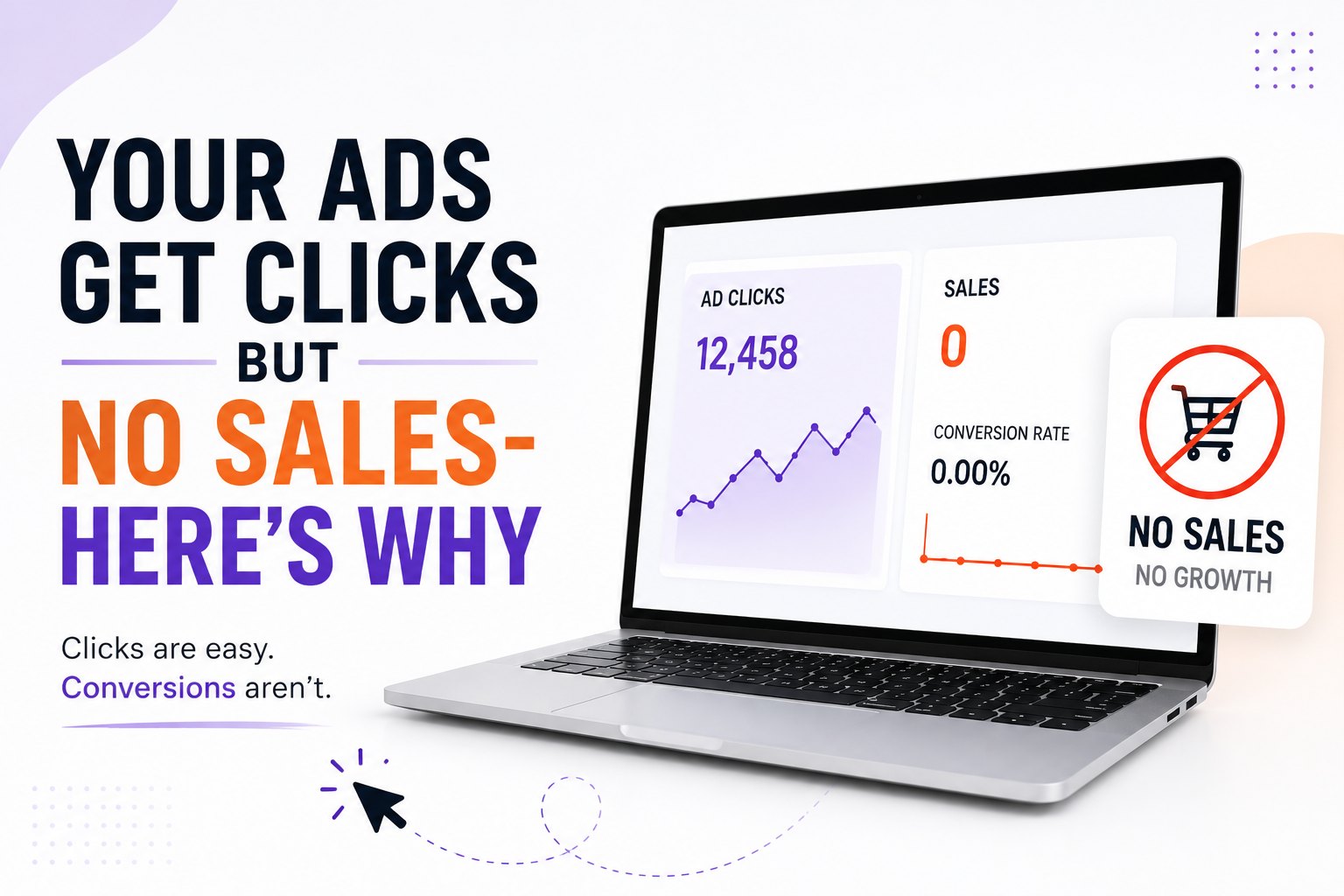
If your ads get clicks but no sales, the leak is after the click, not in the ad. A click means your targeting and creative worked — someone was interested enough to tap. The sale is lost somewhere between that tap and the checkout: a landing page that doesn't match the ad, a slow mobile experience, a weak offer, too much friction to buy, unanswered trust or price objections, or broken tracking that's optimising for the wrong thing. Fix the path after the click and the same ads start paying for themselves.
First, is it actually a problem?
Before you blame the funnel, rule out two false alarms. First, volume: 40 clicks and no sale isn't a verdict, it's noise. Wait for at least 300–500 clicks before drawing conclusions. Second, tracking: in Pakistan, a huge share of sales close over WhatsApp or on delivery, not through an on-site checkout. If you're only counting website purchases, you may be making sales you can't see. Confirm you're measuring every real outcome before you decide the ads have failed — we'll come back to this in reason 7.
The 7 reasons your ads get clicks but no sales
1. Your landing page doesn't match the ad
Clicks don't convert when the landing page doesn't deliver what the ad promised. This is the single most common cause. Your ad promises a specific product, price, or offer — then the click dumps the visitor on a generic homepage, or a page about something slightly different. The mental thread snaps, and they leave. If the ad says “Flat 30% off winter collection,” the page they land on must lead with the winter collection and that exact discount — not your brand story.
The fix: send every ad to a dedicated landing page that mirrors its promise word for word — same offer, same product, same headline. One ad, one page, one action. Never point paid traffic at a busy homepage and hope they find their way.
2. Your page is too slow on mobile
A slow page loses buyers you have already paid to acquire. You pay for the click whether or not the page loads. On Pakistani mobile data, a heavy page that takes five or six seconds loses a large share of visitors before they see a word of your offer — and you've already been charged for every one of them. Slow pages don't just lower conversions; they quietly waste a chunk of your entire budget.
The fix: get your landing page loading fast on a mid-range phone — compress images, cut heavy scripts, and test on real mobile data, not office wifi. Our guide on signs your website is losing customers breaks down the speed fixes that matter most.
3. You're buying cheap clicks from the wrong people
Cheap clicks from the wrong audience never become sales. Not all clicks are equal. Broad, untargeted campaigns — or ones optimised for “clicks” and “traffic” instead of purchases — pull in curious taps from people who were never going to buy. You get a low cost-per-click and feel good about the number, while none of it converts.
The fix: optimise campaigns for the actual outcome you want — purchases, leads, or messages — not clicks or reach. Let the platform find buyers, not browsers. A higher cost-per-click from the right person beats a cheap click from the wrong one every time.
4. Your offer isn't compelling enough to act now
If there is no compelling reason to act now, interested visitors leave and never come back. Sometimes the page is fine and the traffic is right, but the offer gives no reason to buy today. “Quality products, great service” is not an offer — it's wallpaper. Without a clear, specific, time-bound reason to act, an interested visitor bookmarks it, tells themselves “later,” and never comes back.
The fix: lead with a concrete offer and a reason to move now — a real discount, a bundle, free delivery, a limited quantity, or a bonus. Make the value obvious in the first line, and make the deadline real.
5. There's too much friction to buy
Every extra step between wanting and buying quietly kills conversions. Every extra step between “I want this” and “done” loses people. A ten-field form, a forced account sign-up, no cash-on-delivery option, or no way to just message you on WhatsApp — each one is a reason to abandon. Pakistani buyers in particular often want to ask a question before they commit, and if there's no easy way to do that, they drop off.
The fix: strip the path to the bare minimum. Offer cash on delivery, add a one-tap WhatsApp button, cut form fields to the essentials, and make the primary action impossible to miss. Every field you remove lifts conversions.
6. You haven't answered trust and price objections
People won't buy from a brand they don't trust yet, or at a price whose value isn't clear. A first-time visitor from an ad doesn't know you and has no reason to trust you yet. If the page shows no reviews, no real photos, no returns or refund policy, and no proof other people have bought safely, doubt wins — especially for anything paid in advance. Price objections work the same way: if the value isn't clear, the price always feels too high.
The fix: put proof where the decision happens — genuine reviews, real product photos, clear delivery and refund terms, and trust signals like verified badges. Address the price by making the value and the outcome unmistakable before you state the number.
7. Your tracking is broken, so you're optimising blind
If you can't measure conversions, the ad platform can't optimise for them, and neither can you. If your Meta Pixel or Google conversion tracking isn't set up properly, the platform never learns who actually buys — so it keeps serving your ads to clickers, not customers. Worse, you can't tell which campaigns work. Many “my ads don't convert” problems are really “my ads convert and I can't see it,” because WhatsApp and cash-on-delivery sales were never tracked.
The fix: install proper conversion tracking (Pixel plus the Conversions API), track the events that matter — purchases, leads, and message starts — and reconcile online numbers with your real WhatsApp and COD sales. Once the platform can see conversions, it optimises toward them.
A quick diagnostic
Run through this in order — the first “no” is usually your answer.
| Check | You're fine if… |
|---|---|
| Match | The landing page's headline and offer mirror the ad exactly |
| Speed | The page is usable in under three seconds on mobile data |
| Targeting | Campaigns are optimised for purchases/leads, not clicks |
| Offer | There's a specific, time-bound reason to buy now |
| Friction | COD, WhatsApp, and a short form are all one tap away |
| Trust | Reviews, real photos, and refund terms are on the page |
| Tracking | You can see actual purchases, leads, and WhatsApp chats |
The bottom line
Clicks with no sales is a frustrating place to be — but it's also good news, because it means the hard part is working: people want what you're advertising. The money is leaking somewhere after the click, and every leak above is fixable. Tighten the match between ad and page, make it fast, reduce friction, prove you're trustworthy, and measure what actually happens. That's the difference between an ad account that drains money and one that prints it.
If you'd rather not diagnose it alone, that's exactly what our performance marketing and website design teams do — connect the ad, the page, and the tracking into one path that converts.
Frequently asked questions
Why am I getting clicks on my ads but no sales?
Clicks measure interest; sales measure everything after the click. If people click but don't buy, the break is almost always after the ad — a landing page that doesn't match the ad's promise, a slow or clumsy mobile experience, a weak offer, too much friction to buy, or unaddressed trust and price objections. The ad is doing its job; the conversion path isn't.
How long should I run an ad before deciding it doesn't work?
Give a campaign at least 7 days and a meaningful number of clicks — roughly 300 to 500 — before judging it. Below that, you're reacting to noise, not signal. Also make sure your tracking is set up so you can see actual purchases and WhatsApp enquiries, not just clicks, before you call it a failure.
Does a slow website really cost me sales from ads?
Yes. You pay for every click, so a landing page that takes five or six seconds to load on mobile data burns budget before the visitor ever sees your offer. In Pakistan, where most ad traffic is on mid-range phones and mobile data, speed is one of the biggest hidden causes of clicks that never convert.
Should ad traffic go to my homepage or a dedicated landing page?
A dedicated landing page almost always converts better. Your homepage serves many audiences and offers many paths; a landing page matches one ad, one offer, and one action. Sending paid traffic to a generic homepage is one of the most common reasons ads get clicks but no sales.