The short answer
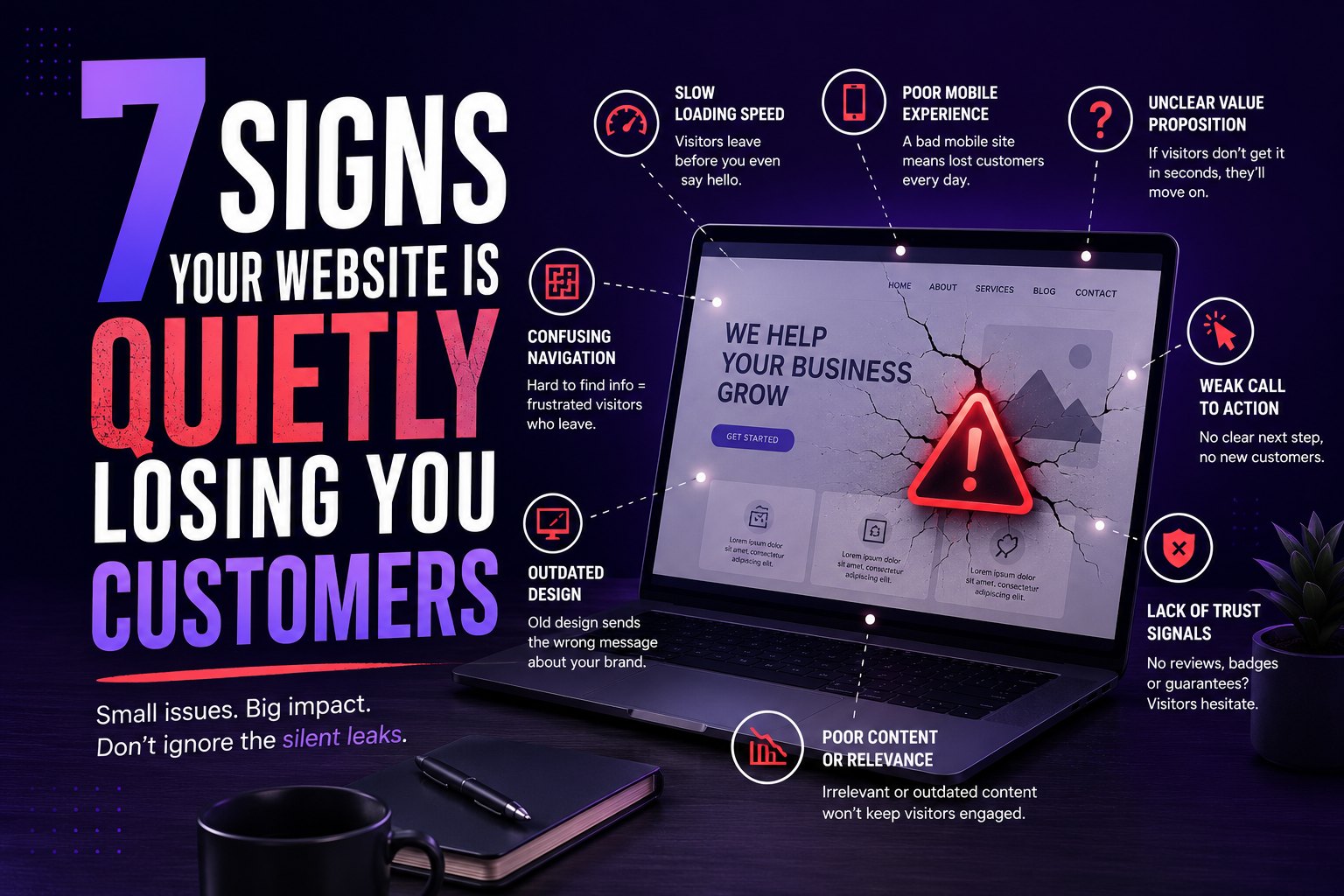
A website is costing you customers when it's slow to load, awkward on a phone, unclear about what you do, missing an obvious next step, dated in a way that reads as untrustworthy, bare of any proof, or invisible on Google and AI search. Each one quietly sends buyers to a competitor before they ever contact you. The good news: every sign below has a concrete fix, and most can be sorted in a focused redesign rather than a ground-up rebuild.
Why your website matters more than ever in Pakistan
Before anyone calls, WhatsApps, or walks in, they check you online — usually on a phone, usually in a few seconds. Your website is the first handshake, and for most businesses it's happening on mobile data, often on a mid-range Android. If that first handshake is slow, confusing, or looks unprofessional, the visitor doesn't email to complain. They just tap back and try the next result. You never see the customer you lost, which is exactly why the leak stays invisible until you go looking for it.
The 7 signs your website is losing customers
1. It takes more than three seconds to load
Speed is the first impression you don't get to make twice. Every extra second of load time gives an impatient visitor another reason to leave — and on mobile data in Pakistan, heavy sites feel even slower than they test. If your homepage takes five or six seconds to appear, a meaningful share of visitors are gone before they see a single word.
The fix: compress and modernise your images, cut unused scripts and bloated page-builders, and put the site behind a CDN. A clean, well-built site should feel near-instant on a phone. Test yours on Google PageSpeed Insights — if you're in the red, that's revenue on the floor.
2. It breaks on mobile
Most of your visitors are on a phone, so if your site was designed for a desktop and merely “works” on mobile, you're serving the majority a second-class experience. Tiny tap targets, text you have to pinch to read, buttons that overlap, a menu that won't open — each one is a small reason to give up.
The fix: design mobile-first, not desktop-first. The phone layout should be the priority, with thumb-friendly buttons, readable type, and a contact or WhatsApp action always within reach. Open your own site on your phone and try to book or enquire in under a minute. If you can't, neither can your customers.
3. Visitors can't tell what you do in five seconds
Open your homepage and imagine a stranger seeing it for the first time. Can they tell what you offer, who it's for, and why you're worth their time — in about five seconds? If your headline is a vague slogan like “Welcome to excellence” instead of a plain statement of what you do, you're making visitors work to understand you. Most won't bother.
The fix: lead with a clear, specific headline — what you do, for whom, and the outcome. “Custom-built websites for Karachi businesses that turn visitors into enquiries” beats “Your partner in digital” every time. Clarity converts; cleverness confuses.
4. There's no obvious next step
A visitor who's interested should never have to hunt for how to act. If your calls to action are buried, vague, or missing — or if every button says something limp like “Submit” — you're letting warm leads cool off and leave. A website without a clear next step is a shop with no counter.
The fix: pick one primary action — book a call, request a quote, message on WhatsApp — and make it impossible to miss. Repeat it down the page. Use action-and-outcome wording (“Book Your Free Strategy Call”) rather than generic labels. One clear path beats five competing ones.
5. It looks dated — so it feels untrustworthy
Fair or not, people judge your business by how your website looks. A design that feels stuck a decade ago — clashing colours, stock clip-art, cramped layouts, walls of text — quietly signals “this business may be out of date too.” In a market where a competitor is one tap away, that impression is expensive.
The fix: invest in a clean, modern design with generous spacing, a consistent colour and type system, and real imagery of your work. Design isn't decoration — it's credibility. When we rebuilt the site for DA Elements, an interior-design atelier, the premium look did as much for trust as any sentence of copy.
6. There's no proof you're any good
Confident claims about yourself only go so far. If your site has no reviews, no testimonials, no case studies, and no examples of real work, a first-time visitor has nothing to reassure them — and doubt is the default. Buyers want evidence that other people like them trusted you and were glad they did.
The fix: put proof where decisions happen. Add client reviews, a portfolio of real projects with the result each delivered, recognisable logos, and verified badges from platforms like Google, Clutch, or GoodFirms. A single genuine, specific testimonial can outweigh paragraphs of self-description.
7. Nobody can find it on Google or AI search
Even a beautiful, fast website earns nothing if no one reaches it. If you don't show up when customers search for what you sell — or when they ask an AI assistant like ChatGPT for a recommendation — you're invisible at the exact moment intent is highest.
The fix: build search visibility into the site, not on top of it. Get the technical foundations right, target the terms your customers actually type, and structure content so it can be quoted by AI engines too. That last part — getting cited in AI search — is a first-mover advantage most local businesses haven't touched yet.
A two-minute self-audit
Open your website on your phone and score yourself honestly. Each “no” is a customer you may be losing.
| Check | Pass if… |
|---|---|
| Speed | The homepage feels ready in under three seconds on mobile data |
| Mobile | You can read everything and tap every button without zooming |
| Clarity | A stranger knows what you do within five seconds |
| Next step | One obvious action (call, quote, WhatsApp) is always visible |
| Design | It looks current and professional, not dated |
| Proof | Reviews, real work, or badges are on the page |
| Findability | You appear when you search your service on Google |
Three or more “no”s? Your website is likely leaking business, and a redesign will pay for itself faster than you'd expect.
Redesign or rebuild — which do you need?
Not every site needs to be torn down. If the foundations are solid — it's fast, it works on mobile, it's findable — and the problems are mostly messaging, layout, and calls to action, a focused redesign fixes the leak quickly and affordably. But if the site is slow, built on a bloated template, unusable on a phone, or invisible in search, patching it is throwing good money after bad; a clean rebuild is the better investment. When we take on a project, we start by telling you honestly which one you actually need — not which one bills more.
The bottom line
Your website doesn't have to be broken to be costing you customers — it just has to be slow, unclear, unconvincing, or hard to find. The businesses that win online aren't the ones with the flashiest sites; they're the ones that remove every small reason to leave. Fix these seven signs and you stop losing the customers your marketing already worked to attract. If you're not sure where your site stands, that's exactly what our website design and development service is built to sort out — starting with an honest look at what's leaking and what to fix first.
Frequently asked questions
How much does a website redesign cost in Pakistan?
It depends on scope. A focused refresh of an existing site — new messaging, layout, mobile fixes, and speed — costs far less than a full custom rebuild with new pages, features, or a booking or e-commerce flow. Rather than a fixed package, we scope the work to what your business actually needs and quote transparently in PKR. Book a free call and we'll give you a range for your specific site.
How long does a website redesign take?
A focused redesign usually takes two to four weeks. A larger custom build runs longer — our recent FabricPro product went from concept to live in eight weeks. Timelines depend on how many pages you need, how much content is ready, and whether custom features are involved.
Do I need a full redesign or just small fixes?
If the foundations are broken — the site is slow, unusable on mobile, or invisible on Google — a rebuild is usually the better investment than patching. If the foundations are sound and only the messaging, layout, or calls to action are weak, targeted fixes can lift results quickly. A quick audit tells you which camp you're in.
Will a new website actually get me more customers?
A website can't fix a weak offer, but it can stop leaking the customers your marketing already sends. Removing the seven blockers in this guide reliably increases enquiries. Pair it with SEO and GEO so more of the right people arrive in the first place.