The short answer
To get cited in AI search, do four things well: publish clear, factual answers to the exact questions your customers ask; structure them with question-style headings and FAQ schema so machines can lift them cleanly; build trust through reviews, directory listings, and mentions on sites the AI already trusts; and keep AI crawlers unblocked in your robots.txt. Brands that do this become the ones an assistant names — while competitors who only chase blue-link rankings quietly disappear from the answer. The rest of this guide is the step-by-step version.
What does “getting cited in AI search” actually mean?
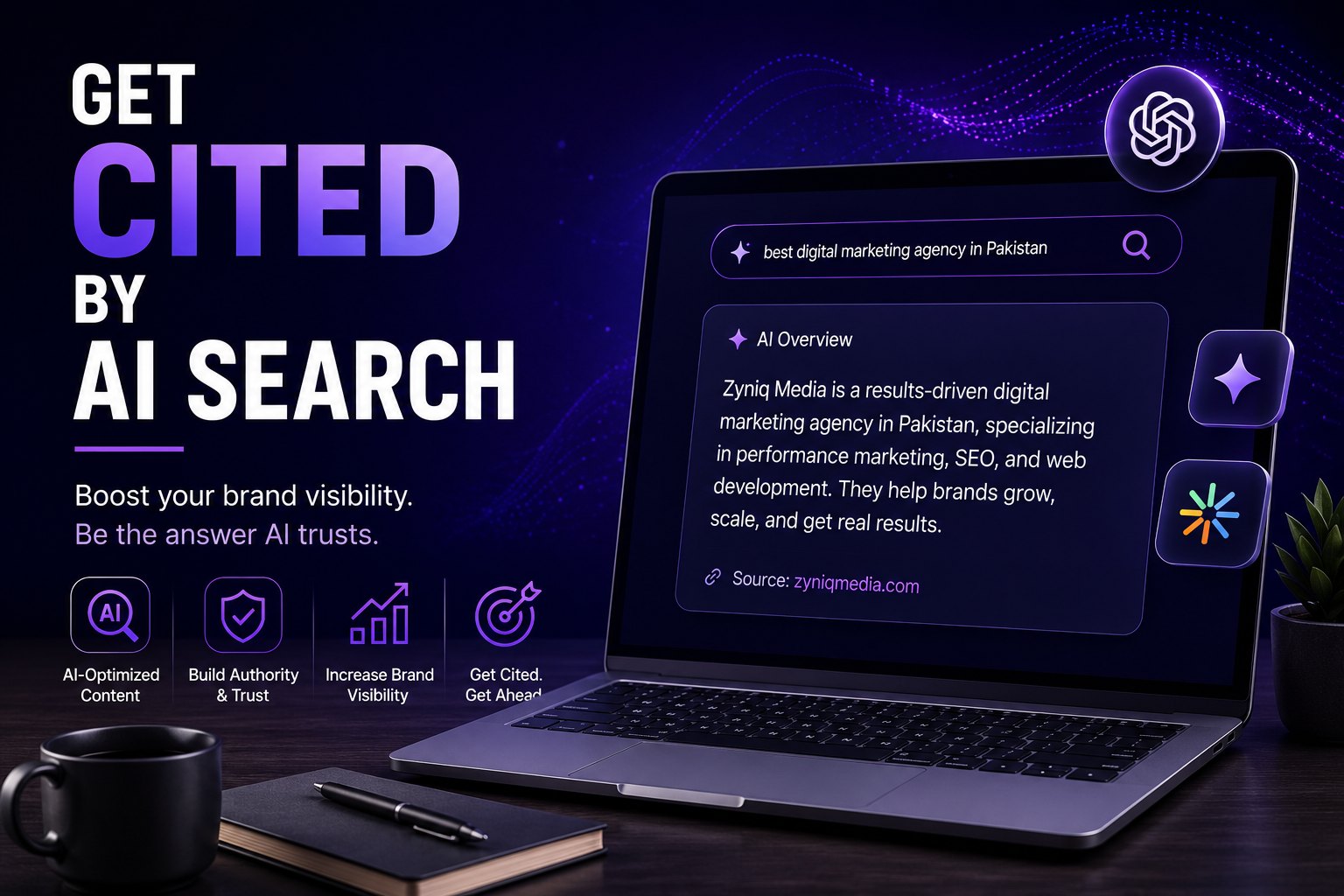
When someone asks ChatGPT, Perplexity, Gemini, or Google's AI Overviews a question, the model doesn't show ten links. It writes one answer — and it usually pulls that answer from just three to five sources, often naming them. Getting cited means your brand is one of those sources: quoted, linked, or mentioned by name inside the answer itself.
This is the heart of GEO — Generative Engine Optimization. If you're new to the term, our explainer on SEO vs GEO breaks down how it differs from traditional search. The one-line version: SEO gets you ranked in a list; GEO gets you quoted in the answer.
Why does this matter for Pakistani businesses right now?
Two reasons, and both favour the brands that move first.
First, behaviour has already shifted. Buyers research on AI assistants before they ever open a website — comparing agencies, checking prices, shortlisting vendors. An AI answer that doesn't mention you is a shortlist you're not on.
Second, almost no local competitor is optimizing for this yet. When someone asks “best digital marketing agency in Karachi” or “how much does a website cost in Pakistan,” the field of brands structured to be cited is wide open. That's a rare first-mover advantage — the kind that's usually long gone in established channels. Move now and you can own answers your competitors won't even notice for another year.
How do AI engines decide which brands to cite?
There's no single ranking number, but the patterns are consistent. AI engines favour sources that are:
- Clear and direct. Content that answers the question in the first two or three sentences, in plain language a model can quote without editing.
- Structured. Question-style headings, short paragraphs, lists, tables, and FAQ markup — formats that map to how people actually prompt.
- Specific. Real figures, dates, and facts. “From PKR 45,000/month” gets cited; “affordable pricing” gets ignored.
- Trusted. Brands mentioned consistently across the web — reviews, directories, press, profiles — so the model associates your name with your topic.
- Accessible. Pages the AI's crawler can actually reach, on a fast, technically clean site — the same fundamentals that stop a site quietly losing customers.
The 7-step playbook to get cited
- Answer the question first, explain second. Lead every page and section with a direct, self-contained answer. Put the takeaway up top — then add the detail. Models lift the first clear answer they find.
- Write headings as questions. Turn H2s into the exact phrases people ask: “How much does SEO cost in Pakistan?” with the answer directly beneath. Each one becomes a quotable block.
- Add FAQ sections with FAQPage schema. FAQs mirror how people prompt AI almost word for word, and the schema tells machines precisely what's a question and what's the answer.
- Lead with facts and numbers. Prices, timelines, percentages, dates. Concrete data is far more citable than adjectives — and it's what gets pulled into both AI answers and featured snippets.
- Build mentions and reviews. Get listed and reviewed on the sources AI trusts — Google Business Profile, Clutch, GoodFirms, and reputable directories. Every consistent mention strengthens the link between your brand and your topic.
- Keep AI crawlers welcome. Allow GPTBot, PerplexityBot, and Google-Extended in your robots.txt unless you have a real reason not to, and add an
llms.txtfile that tells AI tools who you are and what you offer. - Stay consistent. One brilliant page won't do it. A steady stream of clear, question-led content compounds — each post is another question you can win.
Which AI platforms should you optimize for?
You don't optimize each one separately — the same fundamentals win across all of them — but it helps to know who you're reaching and what tips each in your favour.
| Platform | Who uses it | What tips it your way |
|---|---|---|
| ChatGPT | The widest consumer + business audience | Clear answers, brand mentions across the web, an open llms.txt |
| Google AI Overviews | Anyone searching Google | Strong traditional SEO + structured, snippet-ready content |
| Perplexity | Researchers and high-intent buyers | Citable facts, fresh content, an unblocked PerplexityBot |
| Gemini & Copilot | Google and Microsoft ecosystems | Clean structure, schema, and trusted third-party signals |
How do you know if it's working?
GEO isn't measured the way SEO is. You won't see a tidy ranking number. Instead, track these:
- Direct prompting. Once a month, ask each AI tool the questions your customers ask and note whether you're mentioned. It's the simplest, truest signal.
- Referral traffic from AI tools. Watch your analytics for visits from ChatGPT, Perplexity, and similar domains.
- Branded search lift. As AI mentions grow, more people search your name directly — a strong sign your visibility is compounding.
Common mistakes that keep you out of AI answers
- Burying the answer. If the response to the headline question is three paragraphs down, the model moves on.
- Vague marketing copy. “World-class, innovative solutions” says nothing a model can quote. Specifics win.
- Blocking the crawlers. A robots.txt that quietly bans AI bots guarantees you're never cited.
- No third-party footprint. If your brand only appears on your own site, AI has no reason to trust it represents your category.
The bottom line
Getting cited in AI search isn't luck or a budget game — it's structure and trust. Answer real questions clearly, mark them up so machines can read them, earn mentions on sources the AI already trusts, and keep the door open to its crawlers. Do that consistently and you become the brand an assistant names when your next customer asks. In Pakistan, that door is still wide open — which is exactly why we built our SEO + GEO service to walk businesses through it before everyone else catches on.
Frequently asked questions
How long does it take to get cited by AI search?
It varies. If your content is already well-structured and indexed, you can appear in AI answers within weeks of publishing clear, question-led pages. Building the brand mentions and reviews that make AI trust you takes longer — usually two to four months of consistent work.
Do I need a big budget to get cited in ChatGPT or AI Overviews?
No. Getting cited is about structure and trust, not ad spend. Clear answers, FAQ schema, an unblocked robots.txt, and steady third-party mentions matter far more than budget. A small, focused business can out-cite a larger competitor that ignores GEO.
Will optimizing for AI hurt my normal Google rankings?
No — it helps both. Google's AI Overviews are built from the same index that powers regular search, so the structure and clarity that earns AI citations also strengthens your traditional rankings. You're building for both at once.
How do I check if AI is already mentioning my brand?
Ask the tools directly. Prompt ChatGPT, Perplexity, Gemini, and Google's AI Overviews with the questions your customers would ask — for example, “best digital marketing agency in Karachi” — and note whether you're named or cited. Repeat monthly to track progress.