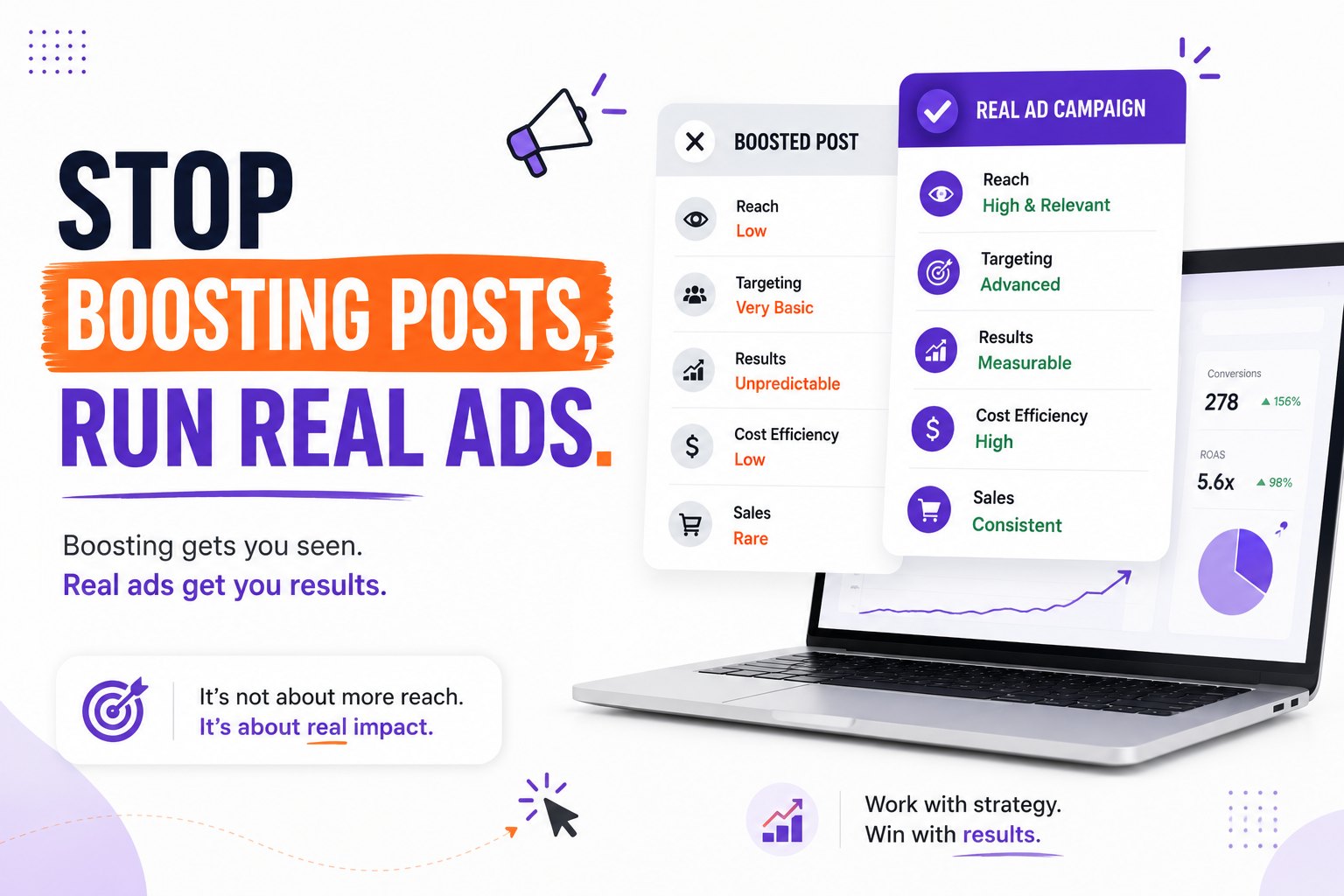
The short answer
Boosting a post is a stripped-down shortcut that optimises for engagement — likes, comments, reach — not for sales. It gives you almost no control over targeting, no way to test creatives, no proper funnel, and no conversion optimisation. So you pay for vanity metrics while real buyers slip past. A campaign built in Meta Ads Manager uses the exact same budget to chase actual business results. If you care about revenue, close the Boost button and open Ads Manager.
What's the difference between boosting and running ads?
Both run on Meta (Facebook and Instagram), so people assume they're the same thing. They're not. Boosting is the one-tap version: pick a post, pick a budget, pick a vague audience, done — and Meta quietly optimises it for engagement by default. Ads Manager is the real tool professionals use: you choose a business objective, build precise audiences, test several creatives against each other, control placements, and optimise for conversions. Same platform, same money — completely different machinery underneath.
Why boosting quietly wastes your budget
1. You can only optimise for engagement, not sales
Boosting tells Meta to find people who will like your post, not people who will buy. That's the default optimisation, and it's the whole problem. Meta is extremely good at hitting the goal you give it — so it delivers cheap likes and comments from people who were never going to become customers. The metrics look busy; the bank account doesn't move.
2. You get almost no real targeting
Boosting gives you a blunt audience; Ads Manager gives you a scalpel. With Boost you get a handful of broad interest and location options. In Ads Manager you can build custom audiences from your website visitors, retarget people who messaged you, exclude existing customers, and create lookalikes of your best buyers. Targeting the right people is most of what makes an ad profitable — and boosting barely lets you do it.
3. You can't test anything
Boosting runs one post, one audience, and hopes. Real advertising is a testing game: you run several headlines, images, and audiences at once, then put the budget behind whatever wins. Boost has no A/B testing, so you never learn what actually works — you just repeat the same guess and pay for it again next month.
4. There's no funnel — just a dead end
A boosted post sends cold strangers to a like button, not a next step. Someone who's never heard of you sees the post, maybe taps like, and moves on. There's no journey toward a purchase, no landing page, no WhatsApp conversation, no retargeting to bring them back. Advertising works as a funnel — awareness, interest, action — and boosting only ever touches the first step.
5. You lose control of where the money goes
Boosting spends your budget wherever it's easiest, not where it converts. You can't properly choose placements, schedule delivery, or control how the budget is spent across audiences. Ads Manager lets you direct every rupee — which placements, which audiences, which times — so your money works where it actually pays off.
6. You're paying for vanity metrics
Likes and reach feel like progress, but they don't pay salaries. Boosting is built to produce exactly the numbers that look good in a screenshot and mean little for the business. A campaign optimised for purchases or leads might show fewer likes — and far more actual enquiries and sales. Judge ads by revenue, not applause.
7. No pixel, no learning, no compounding
Boosting rarely uses your Meta Pixel properly, so the algorithm never learns who buys. Proper campaigns feed conversion data back to Meta, and delivery gets smarter and cheaper over time. Boosted posts don't build that loop — every boost starts from scratch, so you never get the compounding efficiency that makes advertising profitable at scale.
So is boosting ever OK?
Yes — in one narrow case. If a post is already performing well organically and your only goal is quick awareness or reach for a good piece of content, a small boost can extend its life. It's a cheap, fast way to put a little fuel on something that's already burning. But the moment your goal is sales, leads, or messages — anything tied to money — boosting is the wrong tool. Be honest about which one you're actually after.
What to do instead
Move to Meta Ads Manager. You don't need a bigger budget — you need the same budget used properly:
- Pick a real objective. Sales, leads, or messages — whatever your actual business goal is. This single choice changes who Meta shows your ad to.
- Build proper audiences. Retarget website visitors and people who've engaged, exclude existing customers, and test lookalikes of your best buyers.
- Test a few creatives. Run several images, videos, and hooks against each other, then scale the winner and cut the rest.
- Send traffic somewhere that converts. A dedicated landing page or a WhatsApp conversation — not a dead-end post. (More on that in our guide on why ads get clicks but no sales.)
- Install and use your Pixel. Let Meta learn who buys so delivery gets cheaper and smarter over time.
Boosting vs proper ads — at a glance
| Boosting | Ads Manager | |
|---|---|---|
| Optimised for | Likes & engagement | Sales, leads, messages |
| Targeting | Broad, basic | Custom, lookalike, retargeting |
| Testing | None | Multiple creatives & audiences |
| Funnel | Dead-end post | Landing page / WhatsApp journey |
| Pixel learning | Minimal | Compounds over time |
| Best for | Quick awareness of a good post | Actual business growth |
The bottom line
Boosting isn't evil — it's just the wrong tool for almost everything businesses use it for. It's built to be easy, not effective, and “easy” is exactly why it quietly drains budgets across Pakistan every month. The same rupees, run through Ads Manager with a real objective, proper targeting, and a genuine funnel, do something the Boost button never can: bring you customers, not just claps. If setting that up feels like a lot, that's precisely what our performance marketing team does — turn ad spend into measurable results, not vanity metrics.
Frequently asked questions
Is boosting a post the same as running a Facebook or Instagram ad?
No. Boosting is a stripped-down shortcut that promotes an existing post, optimised mainly for engagement like likes and comments. A proper ad built in Meta Ads Manager lets you choose a real objective (sales, leads, messages), target precisely, test multiple creatives, and optimise for actual business results. Same platform, very different outcomes.
Is boosting posts ever worth it?
Occasionally. If a post is already performing well organically and your only goal is quick awareness or reach — not sales or leads — a small boost can extend its life. But for anything tied to revenue, boosting is the wrong tool. Use Ads Manager the moment you care about conversions.
Why do my boosted posts get likes but no customers?
Because boosting optimises for engagement, so Meta shows your post to people likely to like or comment — not people likely to buy. You get cheap vanity metrics and no sales. To get customers, run a campaign optimised for purchases, leads, or messages in Ads Manager, pointed at a proper landing page or WhatsApp.
How much budget do I need to run proper ads instead of boosting?
You can start a real Ads Manager campaign on the same budget you'd spend boosting — even a few thousand rupees a day. The difference isn't the amount you spend, it's how the money is used: proper targeting, testing, and conversion optimisation make the same budget work far harder than the Boost button ever will.